


Robotics
Ground robots and mobile platforms operating autonomously outdoors.
A compact dual-band RTK G-Mouse for evaluation, prototyping, education, and open-sky deployments — the entry point into the SCOUT Series.
Couldn't load pickup availability


Key facts
Choose Your Variant
Both variants use the same dual-band L1/L5 GNSS engine and IP67 housing. The difference is whether your platform needs continuous positioning when satellites are temporarily blocked.
For open-sky surveying, precision agriculture, and static monitoring.
For mobile robotics, AGVs, and signal-challenged environments.
Product Overview
SCOUT Series is Kalmix's integrated RTK GNSS receiver family. Instead of requiring teams to design their own enclosure, cable, antenna mount, and integration, SCOUT packages the GNSS hardware into a compact receiver — ready to plug into your host system.
SCOUT is the entry-level configuration in the series, designed for evaluation, prototyping, education, and open-sky deployments. It's the fastest way to get hands-on with dual-band RTK without committing to a production-grade integration.
The receiver outputs standard NMEA over USB-C and accepts RTCM 3.x corrections from any compatible NTRIP source. For continuous positioning in challenging environments, see SCOUT PRO.

Why Choose SCOUT Series
Enclosure, integrated antenna, cable, and adhesive mount in one unit. No PCB design, no enclosure tooling, no harness work.
Multi-constellation tracking with cm-level RTK accuracy when paired with any standard NTRIP correction stream.
USB-C, NMEA 0183 output, RTCM 3.x input. Reads as a USB serial device on Linux, Windows, and macOS.
RTK+DR version adds a 6-axis IMU to support continuity during short GNSS interruptions on dynamic platforms.
Datasheet, mechanical drawing, NMEA reference, sample logs, and integration guides — published or available on request.
Series Selector
SCOUT is the compact entry configuration for open-sky evaluation and early prototypes. SCOUT PRO adds the stronger GNSS and IMU stack for robots, AGVs, field machines, and B2B integration.
| SCOUT Entry Level | SCOUT PRO Advanced | |
|---|---|---|
| Best for | Open-sky evaluation, education, early prototyping | Robotics, AGV, agriculture, construction, autonomous platforms |
| GNSS | BEKEN BK1662 | Airoha AG3335 |
| IMU | BOSCH BMI325 | ST LSM6DSR |
| RTK | Yes | Yes |
| IMU / DR variant | Available (RTK+DR) | Available (RTK+DR) |
| Starting price | From $99 | From $149 |
How SCOUT Compares
There are several common ways to evaluate RTK hardware. SCOUT sits in the integrated G-Mouse format, optimized for open-sky evaluation, education, and early prototyping.
| SCOUT (Integrated G-Mouse) | Bare Receiver Board + External Antenna | Survey-Grade Module Kit | |
|---|---|---|---|
| Mechanical integration work | None (pre-enclosed, IP67) | Custom enclosure, cabling, mounting required | Custom enclosure, antenna boom, cabling |
| Time to first RTK fix on a vehicle | Hours (mount + plug-in) | Days to weeks (PCB layout, harness, mount) | Days (cabling, mount, configuration) |
| Engineering ownership | Drop-in component | Full RF + mechanical responsibility | Mechanical + cable management |
| Form factor flexibility | Fixed | Maximum flexibility | Maximum flexibility |
| Best for | Open-sky evaluation, education, early prototyping | Custom PCB integrations, OEM at scale | Survey, mapping, geomatics, demanding RTK profiles |
| Typical unit price (RTK-capable) | $99 direct / $149 MSRP | $200–$700+ | $1,500–$5,000+ |
You're validating RTK for open-sky evaluation, education, or early prototyping and want a lower-cost integrated receiver.
You’re designing a high-volume custom PCB integration and have RF + mechanical engineering capacity.
Your application is mapping or surveying with very demanding accuracy and PPK workflows.
Honest comparison — each format has its place. SCOUT is optimized for fast, reliable deployment, not for every use case.
Technical Specifications
Public specifications for SCOUT. Full product documentation, protocol references, and setup guides are available through the Support Hub.
| GNSS | |
| GNSS chipset | BEKEN BK1662 |
| Receiver channels | 200-channel |
| Frequency bands | L1 + L5 dual-band |
| Constellations | GPS / Galileo / BeiDou / GLONASS / QZSS |
| Tracking sensitivity | <-165 dBm |
| Accuracy | |
| Standalone horizontal | <1.5 m open sky |
| RTK fixed horizontal | ≤10 cm CEP |
| RTK correction input | RTCM |
| Time to First Fix | |
| TTFF | <28 s |
| Output Rate | |
| Standard RTK variant | 1 Hz |
| RTK+DR variant | 10 Hz |
| IMU / Dead Reckoning | |
| IMU sensor | BOSCH BMI325 |
| DR availability | RTK+DR variant only |
| Interface | |
| Connector | USB Type-C |
| Cable | Integrated 3 m USB-C cable |
| Output protocol | NMEA 0183 |
| Correction input | RTCM |
| Default baud rate | 115,200 |
| Electrical | |
| Supply voltage | 5 V via USB-C |
| Environmental | |
| Enclosure rating | IP67 |
Integration & Compatibility
SCOUT connects over USB-C, outputs industry-standard NMEA positioning data, and accepts RTCM correction input for open-sky evaluation, education, and early prototyping workflows.
Works with common development and embedded platforms.
Interoperable with widely adopted GNSS data formats.
Designed for robotics, autopilot, and custom control workflows.
Resources for building and validating your integration.
Plug SCOUT into your host device.
Receive NMEA 0183 positioning data.
Connect to an NTRIP caster for corrections.
Send RTCM 3.x data to SCOUT for RTK positioning.
Get started faster with quickstart examples, driver libraries, NMEA message references, and integration guides.
Target Applications
SCOUT is designed for teams evaluating centimeter-level RTK in open-sky environments, student projects, and early-stage outdoor prototypes.
Ground robots and mobile platforms operating autonomously outdoors.

Autonomous trucks and yard vehicles navigating dynamic industrial environments.

Guidance and positioning for farming equipment and field operations.

Machine guidance, site mapping, and survey support in challenging jobsite conditions.
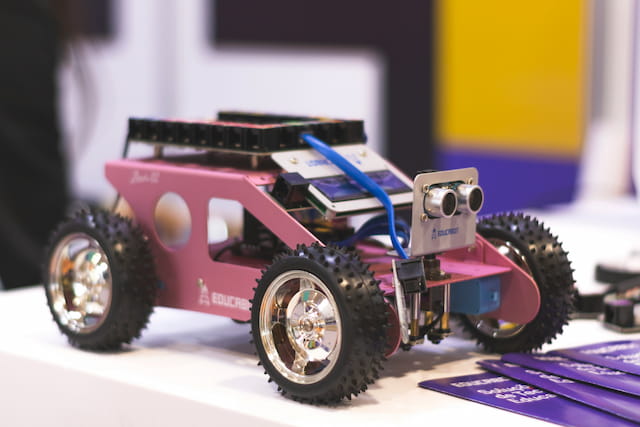
Experimental vehicles and sensor research in outdoor test environments.

Hands-on learning, rapid prototyping, and system evaluation with real RTK data.
Designed for reliable performance in clear-sky outdoor conditions.
Optimized for vehicles and robots operating in real-world motion.
Industrial interfaces and rugged design for system integration.
Quick Facts
Plain-text reference designed for fast lookup and machine-readable extraction.
SCOUT is an integrated RTK GNSS receiver for open-sky evaluation, education, early prototyping, and cost-sensitive outdoor projects.
All values reflect publicly disclosed product specifications. Compatibility with specific software versions may require integration steps documented on GitHub.
Frequently Asked Questions
Practical answers about RTK corrections, integration, mounting, documentation, and support.
No. Centimeter-level RTK accuracy requires RTCM 3.x correction data delivered to the receiver through a host system running an NTRIP client. The correction source can be a public NTRIP service, a regional CORS network, or a local base station. Without corrections, SCOUT operates in standalone GNSS mode with meter-level or sub-meter typical accuracy depending on environment and sky view.
Both variants share the same integrated G-Mouse form factor, USB-C interface, NMEA output, and RTCM correction input. The RTK+DR variant adds a 6-axis IMU based on BOSCH BMI325 and supports 10 Hz output, while the standard RTK variant is intended for 1 Hz GNSS-based positioning. Choose the standard version for open-sky evaluation, education, early prototypes, and cost-sensitive field tests. Choose RTK+DR for moving prototypes and open-sky platforms that benefit from IMU-assisted continuity.
SCOUT is primarily designed as a rover receiver. It can be used in base-like workflows with suitable host software, a stationary reference position, and an NTRIP or RTCM correction pipeline, but it is not a dedicated radio base station kit. For base station or fixed reference setups, contact Kalmix for recommended configuration options.
No. SCOUT is an integrated G-Mouse receiver with the GNSS antenna built into the enclosure. You only need a USB-C connection to your host system and an RTCM correction source when RTK positioning is required.
SCOUT can work with NTRIP services that provide RTCM 3.x correction data compatible with multi-constellation RTK receivers. This may include public CORS networks, commercial NTRIP subscriptions, and self-hosted base station services. The NTRIP client usually runs on the host computer, which forwards RTCM data to the receiver over USB serial.
Yes. SCOUT connects through USB-C and outputs standard NMEA 0183 data over a serial interface. It is designed for common host systems including Raspberry Pi, NVIDIA Jetson, Linux computers, Windows PCs, and macOS systems. Integration examples and reference resources are available through the Kalmix GitHub organization.
SCOUT uses an integrated enclosure and ships with mounting adhesive for direct installation on vehicles, robots, field machines, or test platforms. For best GNSS performance, mount it on a stable top-facing surface with the clearest possible sky view and minimal obstruction from metal structures, payloads, or nearby electronics.
Yes. Volume pricing is available for project and integration teams. Typical inquiries include robotics fleets, AGV platforms, agricultural equipment, research programs, and OEM evaluation batches. Use the contact form to share your target product, application, quantity, and expected timeline.
Public product overview, technical specifications, protocol references, and get-started guides are available through the Kalmix Support Hub. Additional engineering files, mechanical drawings, certification documents, configuration tools, and integration resources may be available on request.
SCOUT includes a 12-month limited hardware warranty against manufacturing defects. Technical support is provided by email for product setup, documentation questions, and basic integration guidance. For volume or OEM projects, dedicated support arrangements can be discussed during the quote process.
Review the GitHub resources or contact Kalmix for integration files, project pricing, and technical support.